Friday, January 15, 2016

Range Rover - Repair and Consignment Sales Redwood City - Range Rover Td6: A last gasp for diesel? - Bosch European Redwood City - (650) 368-3000


The unspoken word hanging in the air over the 2016 Range Rover Td6 and Range Rover Sport Td6: still.
Range Rover, the luxury SUV imprint of Jaguar Land Rover (JLR) and currently a brimming fountain of Yankee cash, is still following through with its plan to offer diesel powertrains to the U.S. market. This, despite the recent unpleasantness known as Dieselgate, Volkswagen’s emissions-cheating scandal.
Talk about climate change. Five years ago diesel was the great green hope, a conventionally handled fuel with about 20% higher fuel economy and lower CO2 emissions. With low-sulfur fuel and post-combustion urea-injection systems to reduce NOx (nitrogen oxides), diesel light-duty vehicles could pass even California’s stringent tailpipe tests.

Today, thanks to VW, diesel’s brand is in disgrace. Meet your new spokesman: Jared.
The good people of JLR understand the timing of their push is less than optimal, but they note heavy industry doesn’t turn on a dime. They make the case, reasonably, that there remains a cadre of unserved Jaguar and Land Rover/Range Rover clients who prefer the range, durability, ready torque and efficiency of diesel.
We’ll see. Range Rover clients can now order either truck with a 3.0-liter turbodiesel V6 (254 hp at 4,000 rpm and 440 pound-feet of torque at 1,750 rpm). The optional diesel will continue across the JLR’s lineup, including the keenly awaited Jaguar F-Pace crossover.

For them, the Td6 puts up some pretty persuasive numbers. Example: The Td6-powered Range Rover gets 32% better fuel economy (EPA combined fuel economy rating of 25 mpg) than its petrol V6-powered twin.
I interviewed JLR’s hushed, oily gyre under the hood of both Range Rover and Range Rover Sport, on and off-road, around Sedona, Ariz., and its next-generation transparency was remarkable. Not only can’t you tell it’s a diesel; you can hardly tell it’s on.

The throttle pickup is nearly identical to JLR’s feisty supercharged six’s. On the highway, a warm warble soars from under a stamped right foot, very like a gasser, and nothing but serene forward thrust.
Milled from compacted graphite iron, the Td6 boasts a super-solid construction (deep skirt, through-bolted, load-bearing oil sump) designed to attenuate diesel-y noise and vibrations. The engine is carried by fancy dual-isolating mounts.

To outwit diesel’s famous knock, the Td6’s injection cycle comprises multiple injection events, with fuel spritzes timed to interfere with the initial detonation’s pressure wave. Other emoluments include acoustic windscreen glass and noise-dampening firewall design.

These exertions are necessary primarily due to the vehicle’s standard (and mandatory) start-stop function. Start-stop is demanding for diesel engines, because it is that first half-second that sees the big spike in transient rocking, when a heavy crank gets spun up against all that compression.
Taming this shuddering has left the Td6 RR an overstuffed, deeply hushed product otherwise. When the engine lights again, you feel the barest frisson through the aluminum-intensive frame, and hear the faintest thrum, as if you were in the wheelhouse of a tugboat and somebody on the fantail started using an electric razor.

It’s all pretty marvelous. So let’s call this application of Rudolf Diesel’s principles what it is: the technical high point of combustion-ignition in passenger cars, the beginning of sunset.

Even before VW’s betrayal, there were good reasons to doubt the long-term prospects of diesel fuel in the American passenger-car fleet, now lingering at about 3% penetration. First, in an age of historically low gasoline prices, diesel fuel prices have trended stubbornly high, an artifact of limited refining capacity and demand from the commercial-trucking sector in a growing economy.

Nationally in January, a gallon of on-highway diesel averaged $2.21 compared with gasoline’s $2.03, according to the U.S. Energy Information Administration (eia.gov). Taxes on gasoline and diesel average about the same: 22%. The price difference just doesn’t want to go away.

Second, diesel powertrains come with a price premium, due primarily to the aforementioned 50-state legal emissions controls, including exhaust treatment with Diesel Emission Fluid (DEF). However, in the case of these two new Range Rovers, the price difference between gas and V6 turbodiesel version ($1,500) is painlessly absorbed into the overall cost of the luxury vehicle.

Third, which I believe is the nail in the coffin: Increased scrutiny by European regulators, who have for years waved past auto makers’ less-than-clinical test results.

It would be hard to overstate European indignation over Dieselgate and the gaming of emissions tests by auto makers generally. In response, the EU Parliament is hammering out new Real Driving Emissions (RDE) requirements, whose purpose is self-explanatory: to take the self-reporting and bench biases out of emissions tests.

That, as any engineer can tell you, is a vastly more stringent standard, and a game changer. VW’s diesels (Audi and Porsche are now also implicated) couldn’t pass such standards as there are without weaseling, allegedly.

As of September 2014, the Euro 6 rules for light-duty passenger cars include a NOx standard of .08 milligram per kilometer.

Mind you: It’s not that auto makers cannot technically make any number the regulators put up. It’s only doubtful they can do it in a way that doesn’t cost them money.

source: http://www.marketwatch.com/story/range-rover-td6-a-last-gasp-for-diesel-2016-01-09
by Dan Neil

http://www.boscheuropean.com

Wednesday, January 13, 2016

BMW - Repair and Consignment Sales Redwood City - The Story Behind The BMW E36 M3: Video - Bosch European Redwood City - (650) 368-3000


M. At BMW, it stands for performance. We identify M car with big power, agile dynamics, and aggressive European styling. But how did they get that way? The BMW M3 is the car that started it all, and a couple weeks ago we saw how BMW developed the first-generation M3.

Well, now BMW has released the second installment in a video series that is promised to cover all five generations of the M3.

The second-generation M3, the legendary E36, which ran from 1992 to 1999. In it we learn that BMW turned its focus from pure competition in the first generation to a combination of track readiness and street comfort. We also learn that the E36 was the first carcar  to feature BMW's VANOS variable camshaft system and sequential M gearbox. VANOS, in particular, was instrumental in giving the car the qualities of both a race car and a comfortable daily cruiser.  

Of course, there is much more to learn about the E36 M3 in this video, as well as some cool images to see of a great car ripping up the road and a warehouse.

The video was done for an international market and not all of the information applies to the United States. However, there is some cool stuff here, and perhaps what you learn will inspire you to do some more research on your own...or to go out and buy a used E36 M3.

source: http://www.motorauthority.com/news/1101633_the-story-behind-the-bmw-e36-m3-video
by Kirk Bell

http://www.boscheuropean.com

Monday, January 11, 2016

VW - Repair and Consignment Sales Redwood City - VW Tiguan Plug-in Hybrid Off-Road Concept Revealed - Bosch European Redwood City - (650) 368-3000

Volkswagen Tiguan GTE concept - 2016 Detroit Auto Show


The GTE mode is for sporty driving. The transmission, throttle, engine, and steering programming are more aggressive. The vehicle uses its full 221 horsepower when GTE mode is activated and is capable of a 6.4-second 0 to 60 mph time and a top speed of 120 mph.

The driver can choose from several driving programs for the 4Motion Active Control all-wheel-drive system: On road (Comfort and Eco), Offroad (Rocks, Sludge and Sand, and Gravel), Sport, Snow, Charge, and Battery Hold.


The Tiguan GTE is based on VW's front-wheel-drive-based MQB platform that underpins the Golf compact cars, among others. However, changes have been made to enable off-road capability. The approach, departure, and breakover angles are improved, and ground clearance increases from 7.1 to 8.9 inches. VW has also added a front skid plate, covered the bumpers in a durable polymer, added tow hooks to both bumpers, installed a pair of LED auxiliary spotlights, and outfitted the roof with high-strength cross rails. Aggressive off-road 16-inch tires provide grip on slippery surfaces.

Volkswagen Tiguan GTE concept - 2016 Detroit Auto Show

Inside, the five-passenger concept has VW's next generation infotainment system, which features a 9.2-inch touchscreen, Apple Car Play and Android Auto, and access to other apps through Car-Net App-Connect. It also responds to gesture control commands. All of the controls on the center stack are touch sliders, which is not a good idea.

Volkswagen is yet to show the version of the Tiguan that the United States will get, but says it will be available in 2017 and be offered with a longer wheelbase and a seven-passenger variant.
We suspect that the plug-in hybrid technology in the Tiguan GTE concept will make it to the production version, as well as several other VW vehicles. The off-road features probably won't be offered for this family hauler.

source: http://www.motorauthority.com/news/1101771_vw-tiguan-plug-in-hybrid-off-road-concept-revealed-ahead-of-detroit-auto-show#image=100541763
by Kirk Bell

http://www.boscheuropean.com

Friday, January 8, 2016

Audi - Repair and Consignment Sales Redwood City - Audi TT: car review - Bosch European Redwood City - (650) 368-3000


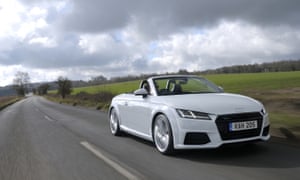
Fiddler with the roof: go for Audi’s soft top TT roadster and you lose the two little seats in the back, but you gain the open sky


MPG: up to 61.4
Top speed: 155mph
Once you’ve decided to splash your cash on a neat hedonistic sports car, you have one further indulgent decision to make. Do you go for the coupĂ© or the open-top roadster? Closed or open? Groomed or wind-blasted? Swot or swank? In the coupĂ© you get the roof and two cramped yet functional perch seats in the back. In the roadster you lose the roof and you lose those tiny seats. This means you also lose your ability to offer a viable transport solution for your teenage daughter’s netball team. Which was how I came to make the same 2.7-mile round trip six times in a row. Each time I asked the girls the same two questions: what brand of car is this? And what does TT stand for?

Not one of the girls got either question right (Audi and Tourist Trophy). But they all loved the car because: “It’s sooooo cute!” And they are absolutely right about that.

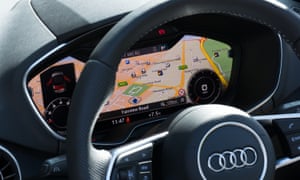
Screen saver: the digital dash makes for a wonderfully uncluttered cabin

The first TT rolled out of the Audi factory in Gyor, Hungary, in 1998. Its Bauhaus curves and teardrop roofline, vaguely reminiscent of a slightly squished VW Beetle, gave it instant traction with speed enthusiasts. It was a driver’s car for those without the budget, or the cojones, to carry off a Porsche. A year later the soft-top version joined the fray and its double rabbit-ear roll hoops made it a favourite across the board.
This is now the third generation, and each iteration has built on the shoulders of the last. It has a multilayered fabric roof that folds in seconds. A wind deflector pops up behind you so the cabin stays draught free even on a cold winter’s day. The open roof also gives passersby a chance to admire the cabin. It’s proper posh, a masterclass in leather upholstery. When you find yourself idly tracing the stitching with a lazy finger you realise you are in the realm of the boutique dungeon, not a car interior. The dash has been upgraded to a virtual cockpit – dials and gauges are all now digital – which creates a wonderfully uncluttered space.

And to drive? The TT hasn’t always been revered for its performance, but third time round, Audi’s engineers have nailed it and created something really dramatic. It’s irresistible. The TT leaps into corners with relish and wolfs its way up and down swooping hills in spectacular fashion. There’s a selection of engines on offer, from the green-fingered 184bhp 2-litre TDI which does 61 mpg, to the bully-boy 227bhp 2-litre TFSI Quattro which does 0-62 in under 5 seconds, but drinks twice as much fuel.

And so, my decision? The roadster – sorry, netballers.

source: http://www.theguardian.com/technology/2016/jan/03/audi-tt-car-review-martin-love
by Martin Love

http://www.boscheuropean.com

Wednesday, January 6, 2016

Mercedes - Repair and Consignment Sales Redwood City - 2017 Mercedes-Benz E-Class Teased In New Video - Bosch European Redwood City - (650) 368-3000


The all-new Mercedes-Benz E-Class is just a week out from its debut at the 2016 Detroit Auto Show. The car will arrive in showrooms later this year, as a 2017 model, and has been in the works for more than four years, with much of the development handled in some of the globe’s most extreme conditions.


Over the course of the past several months we’ve been receiving bits and pieces of information on some of the new features engineers have needed to test. For example, we’ve learned about the car’s advanced autonomous driving capabilities, which will include automatic lane changing, and we also got an early look at the lavish interior. Heck, we’ve even had a glimpse of the exterior completely unmasked. Now we have a new teaser video that shows the advanced headlights of the new E-Class.


Mercedes says the new E-Class will feature its Multibeam LED headlight technology, with each headlight unit coming with 84 individually-controlled LEDs. This enable high-precision lighting of the car’s high beam so the light path can be controlled in a way that doesn’t bother other drivers. The result is that cars equipped with the technology can safely be driven with the high beams left permanently on, though this type of feature is still not allowed in the United States.


source: www.motorauthority.com
by Viknesh Vijayenthiran

http://www.boscheuropean.com

Monday, January 4, 2016

Jaguar - Repair and Consignment Sales Redwood City - Ian Callum Tells The Story Of How He Became A Designer: Video - Bosch European Redwood City - (650) 368-3000


Ian Callum has been responsible for some of the most beautiful cars on the roads over the last few decades, with most of his career actually spent with Ford Motor Company [NYSE:F], though most will likely recognize his more recent efforts at Aston Martin and Jaguar. Some of his most impressive works include the original Aston Martin Vanquish, the Jaguar F-Type and the rare Ford RS200 homologation special.


Callum is also a huge car nut, even going so far as to commission a bespoke Jaguar Mark 2, but he’s also very much an approachable, likable ‘car guy,’ something that can’t be said for many of the stuffy types you often find in design circles, especially those with talents on the same level as Callum’s.
Watch as the 61-year-old tells the story of his life-long passion for car design and how he turned that passion into a career. And there might just be something in the water in the small Scottish town of Dumfries where Callum grew up as his little brother Moray Callum is also a noted automotive designer and is currently in charge of the design team at Ford.

source: http://www.motorauthority.com/news/1101585_ian-callum-tells-the-story-of-how-he-became-a-designer-video
by Viknesh Vijayenthiran

http://www.boscheuropean.com