Patent drawings for a vehicle with distinct BMW-design cues recently
surfaced and were initially thought to be for a new research vehicle from the
German automaker, one equipped with a hydrogen fuel cell stack. It’s since been
revealed that the patent drawings are in fact for a BMW research
vehicle, but one equipped with a more conventional plug-in hybrid drivetrain
rather than a fuel cell.
According to Autocar,
the patent drawings, which first appeared on Chinese websitePC Auto (via China Car News),
depict a potential BMW rival to Volkswagen’s 261-mpg XL1 plug-in
hybrid. For instance, both are shaped like a tear drop when viewed from above,
with a wider front and narrower tail, and both have sealed off, skinny wheels
to help aid their aerodynamic efficiency.
BMW’s design is a little more practical than the XL1, as
it’s said to feature four seats. But this has added a weight cost to the car,
with the BMW said to weigh as much as 2,535 pounds or close to 800 lbs more
than that the XL1. BMW’s design is said to be more aerodynamic, though, thanks
to a 0.18 coefficient of drag versus a 0.19 Cd for the VW.
As for the drivetrain, it consists of a
turbocharged 1.0-liter twin-cylinder engine driving the front wheels and an
electric motor powering the rear pair. A next-generation battery
design said to offer improved energy density and faster charge
times than current designs is used and most likely featured in the vehicle
floor. source: http://www.motorauthority.com/news/1100765_mystery-bmw-is-a-plug-in-hybrid-research-vehicle by Viknesh Vijayenthiran http://www.boscheuropean.com
Unfortunately, as this is a research vehicle, any production
version—if in fact BMW is actually planning a production version—is likely
years away. Recall that BMW often develops research vehicles that aren’t intended
for production. Only this summer, the automaker rolled out i8 and 5-Series Gran
Turismo prototypes fitted
with fuel cells.
Photos of Mercedes-Benz’s updated SL hit the web last week
so we already know about the cosmetic changes made to the car, which feature
primarily at the front. Now, however, the car has made its debut at the Los
Angeles Auto Show and we have all the juicy details to tell you.
The updated SL goes on sale late next spring, as a 2017
model, and we’re glad to report that more power has been added to the base car.
The luxury convertible also benefits from Mercedes’ latest nine-speed automatic
transmission, though the Mercedes-AMG sledgehammers stick with their
seven-speed Speedshift auto.
The range kicks off with a new SL450 model, which replaces the SL400 added for
2015. This base model is still powered by a twin-turbocharged 3.0-liter V-6 but
now there’s 362 horsepower and 369 pound-feet of torque on tap, up from 329 hp
and 354 lb-ft previously.
The SL550 continues with its twin-turbo 4.7-liter V-8, which
was upgraded to 449 hp and 516 lb-ft for 2016, while Mercedes-AMG’s SL63 and
SL65 continue with their respective twin-turbo 5.5-liter V-8 and twin-turbo
6.0-liter V-12 engines. The SL63 is good for 577 hp and 664 lb-ft while the
SL65 throws down a massive 621 hp and 738 lb-ft. The V-12 model is the quickest
of the bunch, needing just 4.0 seconds to hit 60 mph. Top speed is limited to
186 mph.
Performance of the cars can be adjusted by the standard
Dynamic Select driving modes selector. Thanks to this feature, at the touch of
a button the driver can adjust numerous vehicle settings such as the setup for
the engine, transmission, suspension and steering, ranging from fuel-saving to
sports modes.
Steel suspension is standard and features continuously
variable dampers, which can be adjusted via the aforementioned Dynamic Select
system. As an option, Mercedes offers its Active Body Control with the latest
curve tilting function that debuted in the S-Class Coupe and Convertible
models. This system helps to reduces body movements when moving off, braking
and cornering by adjusting the suspension spring struts constantly via
hydraulic means.
The exterior of the latest SL is dominated by the new LED
headlights, hood and grille. Inspiration came from the legendary 300 SL
Panamericana racing car with its steeply raked radiator grille. The
grille on the new SL is more prominent and blends into a sporty,
Mercedes-AMG-designed body kit that’s now a standard feature. The kit includes
an A-wing design at the front that leads into a splitter matching the body
color. Finally, two powerdomes on the hood invoke the sporting heritage of the
SL.
The changes to the rest of the car are much more subtle.
There have been tweaks made to the tail lights and some of the body panels have
been massaged to create a more athletic look. The standard wheels measure 19
inches across and come in a five-spoke design. As for the roof, it remains a
retractable hardtop that can be operated at speeds of up to 25 mph.
In the cabin, there is a new three-spoke, flat-bottomed
steering wheel with a magnesium structure and ergonomic grip. Twelve control
buttons provide access to the menu navigation in the instrument
cluster as well as the audio system, phone and voice activation. The main
instrument cluster remains a combination of digital and analog elements, and
this is joined by a redesigned clock and a new, slightly larger infotainment
screen. Apple CarPlay smartphone integration is also available with the
addition of the car’s Smartphone Integration package.
Then there are all the electronic safety and convenience
features, either standard or available. These include automatic braking,
autonomous mode for highways, lane keep assist, parking assist, and blind spot
and cross traffic warning. There is also the Pre-Safe Plus system which helps
to prevent further injury when hit from behind. The standard audio system is a
10-speaker setup from Harman Kardon. An even more sophisticated sound is
produced by an avaialble Bang & Olufsen BeoSound setup with 12 speakers.
In 1988, race car driver Andy Wallace took the top
spot at Le Mans. He did so in the Silkcut-liveried Jaguar XJR-9 LM. Since then,
that car has become an iconic machine and is instantly recognizable in its
purple, yellow, and white paint scheme. The car was built by Tom Walkinshaw
Racing, and it's powered by a 7.0-liter V-12 that produces between 750 and over
1,000 horsepower depending on how it's tuned. The top speed is north
of 245 mph.
Wallace was recently reunited with his Le Mans-winning
machine, and he was also introduced to the Jaguar XJR super sedan. Under the
lights at Silverstone, Wallace hopped behind the wheel of both
vehicles to celebrate his victory back in 1988. This marked the first time that
the XJR-9 had actually been driven at night since it slashed a path down the
Mulsanne straight all those years ago.
The road-going XJR is down on power, having just 545
or so horsepower by way of its supercharged 5.5-liter V-8. It does have LED
headlamps though, which should prove a bit nicer than the units on the race
car. Additionally, this LED setup is a first for Jaguar. The XJR won't hit the
240-mph mark, but if it did it would certainly be aided by the upgraded
lighting compared to what Andy Wallace had to contend with back in '88.
Still, as good as the XJR might sound... it can't hold a
candle to that wailing V-12 nestled deep inside the chassis of the Le Mans
winner.
While Volkswagen may still be months away from announcing a
recall in the United States for vehicles found to have “defeat device” diesel
emissions cheating software (recalls
in Europe are expected to start in January 2016), the automaker this week
announced a “Goodwill Package” that will financially compensate some owners
here in the States.
The package includes a $500 prepaid Visa card that can
be spent anywhere plus a $500 VW dealership card that can be used at any of the
automaker’s stores. The package also includes free 24-hour roadside assistance
for three years. VW says it hopes owners see this as a first step towards
restoring trust.
Right now, the package is only being offered to owners of
VW-branded vehicles fitted with the 2.0-liter TDI diesel engine affected by the
emissions cheating scandal; but the same will be offered to Audi owners in
coming days. Furthermore, owners of VW vehicles (and numerous Audis and even
some Porsches) with the 3.0-liter TDI the EPA recently alleged to also
have emissions cheating software aren’t eligible yet, as VW is still
investigating the matter.
Owners of the following vehicles are eligible for the
package.
VW Jetta TDI (Model Years 2009 – 2015)
VW Jetta SportWagen TDI (Model Years 2009-2014)
VW Golf TDI (Model Years 2010-2015)
VW Golf SportWagen TDI (Model Year 2015)
VW Beetle TDI and VW Beetle Convertible TDI (Model Years 2012-2015)
VW Passat TDI (Model Years 2012-2015)
Full details on the package and eligibility can be found on
the special websidtewww.vwdieselinfo.com that VW has set up for concerned
owners in the U.S.
Unfortunately for VW, its troubles show no sign of abating.
The automaker is still working on a fix for the 11 million cars already
confirmed to have the emissions cheating software, and now there’s potentially
hundreds of thousands or perhaps even millions of more vehicles affected due to
the EPA’s claimed discovery of the software on VW’s 3.0-liter diesel models. On
top of all this, VW has discovered that around 800,000 of its cars had
their CO2 levels—and thus fuel consumption figures—understated
during CO2 certification.
Audi has started the first public road trials of its
next-generation A7. We’re still at the test mule stage, which means
the engineers are testing the new mechanicals within the makeshift body of a
current model, but even at this early stage we can already gather a few
details.
It appears the length of the new A7 won’t be changing but
width should be up, as evidenced by the modified wheel arches on this mule.
This ties in with claims that the new A7 will sport a wider, more radical look.
One element that we know will carry over is the squared-off Kammback rear.
Overseeing the design is new Audi design chief Marc Lichte,
who says we can expect greater differentiation between the new A7 and the
mechanically-similar, next-generation A6. The new look was previewed on Audi’s
forward-looking Prologue concept, which Lichte and his team worked on after
completing the designs for the new A6 and A7 as well as the next-generation A8.
The platform underpinning the car is the
Volkswagen Group’s MLB Evo, which made its debut in the 2017 Q7 and has since spread to the 2017 A4. The new platform promises a
significant reduction in weight as well as compatibility with more alternative
powertrains.
The base engine should be a turbocharged 2.0-liter
four-cylinder delivering 252 horsepower and 273 pound-feet of torque. This unit
makes its debut in the 2017 A4. A plug-in hybrid A7 is a certainty,
and there should also be a battery-electric option at some point. Audi has also
hinted at a fuel
cell-equipped A7. The good news is that we’ll also see sporty S7 and RS 7
models once again.
The new A8 will arrive first, with its reveal set to take
place next year. The new A6 and A7 will follow in 2017. In the United States,
the new A7 is expected to arrive as a 2019 model.
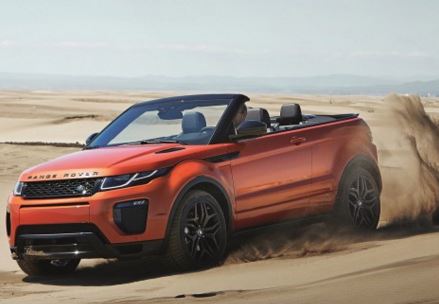
Where Nissan failed with the Murano CrossCabriolet, might Land Rover
succeed with a convertible version of its Range Rover Evoque? We’ll get the
chance to find out the answer to that very question in the coming years as the
British automaker is launching a new Range Rover Evoque Convertible. The vehicle has
been spied testing for the past several months, and now it’s been revealed
ahead of its world debut at the upcoming 2015 Los Angeles Auto Show.
High-riding convertibles are still somewhat of an oddity in
the automotive landscape, yet it’s a segment Land Rover sees potential in.
There have been
convertible Land Rovers before but this is the first time one has been
launched by the automaker itself. Fortunately, Land Rover isn’t charging a huge
premium for the drop-top option. The starting price comes in at $51,470,
including a $995 destination charge, which is only about $4k more than the
price of a comparable Evoque three-door.
Also helping the Evoque Convertible is styling that’s miles
ahead of the ungainly Murano CrossCabriolet. The design team has done a great
job at maintaining the edgy lines of the standard Evoque when the Evoque
Convertible’s roof is in place. And when the roof is down, the vehicle has a
wedge-like profile that gives it a sporty look. The roof is an automated fabric
unit that folds away flush with the rear bodywork in just under 20 seconds. New
frameless doors have also been developed to ensure a clean profile when the
roof is stowed.
As the Evoque range was only updated this year, there aren’t
many other differences to be found on the Evoque Convertible. Like all Evoques
(sold in the United States), the Evoque Convertible is powered by a
turbocharged 2.0-liter four-cylinder engine good for 240 horsepower and 250
pound-feet of torque. The engine is paired with a nine-speed automatic
transmission and spins all four wheels. Unfortunately, losing the roof has seen
extra weight piled on (most likely due to additional reinforcements) as the
curb weight of the Evoque Convertible is a hefty 4,268 lbs. The 0-60 mph run
will take you 7.8 seconds and the top speed is 112 mph. Towing Capacity is
approximately 3,300 lbs.
The cabin is pretty much identical to what you find in the
fixed-roof models. However, the vehicle comes standard with fixed twin rear
seats, with a central bolster, and revised quarter trim speakers. Land Rover
says there’s room for four but we’re guessing only small children will be able
to fit up back. Regardless of whether the roof is up or down, there’s 8.9 cubic
feet of storage, and this can be extended thanks to a ski hatch that can enable
longer items to be carried. For the tech fans, there’s the new In Control Touch
Pro infotainment system which features a 10.2-inch, high-resolution touchscreen
display.